BEST GAMES

Little Misfortune

Fran Bow 4
Little Misfortune 2

Among the Sleep
SIMILAR GAMES

Little Misfortune Full Game

Night in the Woods

Little Nightmares 2025

Sally Face



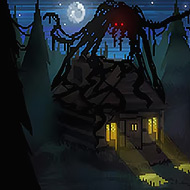



You are sitting in the living room watching Beni make a decision that feels small. He is a husband and a father — Nadia waits in the next room, Kaila is asleep — and the choice in front of him looks like a lifeline. Pikabuu: STOP is a psychological visual novel that builds its horror not out of monsters or jump scares but out of that single moment of weakness, and every second you spend with it is a reckoning with what comes after. The game has earned a 95% positive rating on Steam across more than 200 reviews, with players consistently describing it as something that hit them harder than they expected for a production with a PlayStation 1-era visual style.
| Genre | Psychological horror visual novel |
| Platform | Windows, Android |
| Endings | 6 (2 good, 4 bad) |
| Controls | WASD to move, Shift to run, Space to advance dialogue, E to interact |
| Languages | English, Portuguese-Brazil, Russian, Chinese (Simplified), Vietnamese |
The premise is deceptively grounded. Beni is a family man living within his means — not struggling, not wealthy, just content. Then a single unwitting decision pulls him toward online gambling, and the game traces with unflinching specificity what happens next. There is no fantasy framing here, no supernatural cause. The horror in Pikabuu: STOP is the horror of a real pattern: a loan taken, a debt that grows, a win that turns out to be a scam the moment you try to withdraw. Players who have watched someone go through something similar tend to find the game difficult to sit with in ways that a conventional horror title could never manage.
The control scheme is intentionally simple. You walk through Beni’s home, advance dialogue with Space, and interact with objects using E. There is nothing mechanical to master. That simplicity is the point — the game refuses to let skill or reflexes stand between you and the story. What it demands instead is that you actually read, actually sit with the consequences of each dialogue choice, and resist the urge to look for a loophole that does not exist.
The domestic setting does a lot of work. Moving through the same rooms repeatedly — the kitchen where Nadia waits, the space Kaila occupies — means that every return feels different as Beni’s situation deteriorates. Players in the community often describe the first hour as deceptively calm, with the weight arriving gradually rather than as a single moment.
The branching structure of Pikabuu: STOP is built entirely around Beni’s choices regarding debt and family. Two paths lead to something approaching recovery; four lead to outcomes that range from painful to harrowing. The clearest route to a good ending is refusing every gambling invitation from the beginning — but most players do not do this on a first run, either because they do not realize how consequential the early choices are, or because they follow what feels like the natural narrative momentum.
The bad endings are not equivalent. Some players reach an outcome where Nadia leaves after being abused and Beni, confronted by debt collectors and alone, eventually dies — with the game’s perspective shifting to Nadia and Kaila surviving without him. Others reach an ending where Beni’s desperation leads him somewhere far darker, and Nadia is forced to act to protect Kaila. The community consensus is that Ending 6, which players describe as the one that made entire livestream chats go quiet, carries the most emotional weight. It is also the one most likely to stay with you after the screen fades.
First-time players frequently miss that certain choices in the early sections permanently close off good endings. Once Beni takes a second loan or ignores Nadia’s first warning, specific routes are locked. Completionists going for all six endings typically need at least three full playthroughs, paying close attention to the decision points that initially read as minor.
Pikabuu: STOP uses a low-polygon, PlayStation 1-era aesthetic, and this is one of the most discussed elements in player communities. Supporters argue that the deliberately lo-fi graphics work in the game’s favor — they create enough visual distance from realism to make the domestic violence and gambling themes manageable to process, while the facial expressions and body language still convey enough to land emotionally. Critics point out that some character animations, particularly during confrontations, undercut the tension the writing builds.
The use of generative AI for textures and some character facial expressions has also been a topic of debate in the community. The game is transparent about this in its credits, which partially softened the conversation, but players who care about artisanal production will want to know it going in. What no one disputes is that the sound design carries weight — the piano arrangements, particularly the one that plays after Ending 6, are consistently praised even by players who bounced off the visual presentation.
Sensitive players should know that Pikabuu: STOP contains depictions of domestic violence in a realistic context. The game addresses this in its own content warnings, but the framing is not exploitative — it exists to make the moral stakes of Beni’s spiral undeniable rather than to shock for its own sake. This is a game that knows exactly what it is doing with difficult material.
The most common mistake is treating the early dialogue choices as flavour. Players accustomed to visual novels where the first act is largely setup tend to speed through the initial exchanges between Beni and Nadia, or between Beni and the people who invite him into gambling circles. By the time the consequences of those choices become visible, the window to change course has already closed.
A second common error is misreading Nadia’s reactions as optional feedback. The game does not label her responses as warnings, but experienced players on their second run immediately recognize that every time Nadia pulls back or changes her tone, it is a signal that a checkpoint has passed. Early players who engage with her dialogue carefully — who stop and let her speak fully rather than skipping — consistently report better outcomes without knowing why until it becomes clear in retrospect.
Players who want the good endings benefit from approaching each scene with one question: what would someone actually trying to protect their family choose here? The game punishes rationalizations. It does not reward clever workarounds. Players who try to split the difference — taking one loan but swearing off the next — find that Pikabuu: STOP tracks those patterns and applies them to the ending accordingly.
The two good endings are both rooted in Beni refusing the initial temptation and seeking to address financial pressure through legitimate means. The earliest decision point — whether Beni accepts the first gambling invitation — is the most significant gate. Players who pass that point without engaging have the clearest path forward. Later decision points involving Nadia’s trust and Beni’s willingness to be honest about the family’s situation also contribute, but the early refusals carry the most weight across the branching structure.
There are six total endings, determined by a combination of Beni’s financial decisions, how he treats Nadia and Kaila across the game’s scenes, and whether he attempts to conceal or confront the spiral he has entered. The two good endings differ in their tone but both involve Beni remaining in the family’s life in some functional capacity. The four bad endings reflect different degrees of failure, with Ending 6 representing the outcome where Nadia’s choices — not Beni’s — become the final act of the story. The game saves state between sessions, so players replaying for alternate endings can use save slots to branch from earlier decision points rather than replaying from the start each time.
A single playthrough runs roughly 40 to 90 minutes depending on reading pace and how much time is spent exploring the environment. Seeing all six endings requires multiple runs — most players report between three and five playthroughs to unlock everything, with the completionist community tracking specific decision trees in guides on itch.io and in discussion threads. The game’s length and price point (around one dollar on itch.io) are a common subject of positive comment; players frequently describe it as one of the most memorable short games they have spent money on.
Pikabuu: STOP earns its place in the conversation about narrative games that use the horror framework to explore something true. Beni’s spiral is not sensationalized — the scam site that vanishes the moment he tries to withdraw, the silence from Nadia that grows more pointed with each bad choice — these are recognizable because they are real patterns, rendered in lo-fi visuals and spare dialogue that somehow make them hit harder than a polished production might. If you can sit with what it shows you, the two good endings feel genuinely earned in a way that stays with you after Kaila’s last scene fades from the screen.