BEST GAMES

Little Misfortune
Fran Bow 4
Little Misfortune 2

Among the Sleep
SIMILAR GAMES

Little Misfortune Full Game
Night in the Woods

Little Nightmares 2025

Sally Face


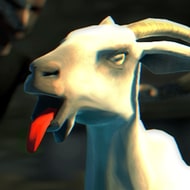
Goat vs Zombies does not ease you in with tutorials or objectives. You are a goat. There are zombies. The ram button, the lick button, and the jump button are all you need to understand, and within thirty seconds of loading the first level you have already headbutted a zombie into a parked car and discovered that the explosion this produces launches two more zombies off the edge of the map. That chain reaction — ram, collision, explosion, airborne zombie — is the entire design philosophy expressed in a single moment of accidental physics.
The goat has four inputs that matter: movement via WASD or arrow keys, a jump, a ram that drives the goat’s horns into whatever is directly ahead, and a lick that extends the tongue to grab distant objects and drag them. Each of these has overlapping uses. The ram clears zombies directly but also dislodges objects in the environment. The lick retrieves items from a distance but can also grip zombie limbs and drag them across the map. The jump clears obstacles and, combined with the ram at the right moment, sends the goat forward at a speed the standard movement speed does not suggest is possible.
The physics system is the game’s main content generator. Goat vs Zombies is built around rag-doll collision responses — zombies tumble, bounce, and pile up in ways that are not scripted but emerge from the physical properties of the objects involved. A zombie hit by a rammed car does not animate through a preset death sequence; it registers the force and responds according to where the force was applied. This produces outcomes that are different every time, which is why players can spend significant time on two levels and find that the experience does not feel repetitive in the way that a more scripted game would after the same duration.
The timer is the only real structural pressure Goat vs Zombies applies. Bonus time tokens are scattered across both levels, and collecting them extends the countdown. Players who ignore the tokens in favour of pure destruction — which is most players on a first session — find the clock ending their run before they have explored everything the levels contain. By the time you understand that the timer is a resource to be managed rather than a deadline to race against, you are probably already replaying with a more deliberate approach to collecting the bonus tokens alongside the zombie chaos.
The game contains two maps, each with a collection of hidden objects, secret interactions, and environmental setups that the game does not signal in advance. The slide is one of the most memorable — a ramp structure that functions as a launch surface when you drag an object up to the top using the lick mechanic and push it toward a cluster of zombies waiting at the base. The game’s description calls this “zombie superbowl,” and the name is accurate. Getting the angle right requires a few attempts, but once the physics clicks the resulting chain reaction is consistently satisfying in a way that feels genuinely discovered rather than designed.
The roller coaster is the other major environmental feature. Riding it while surrounded by zombies produces outcomes that are mostly chaotic rather than strategically useful, but the ride itself is a set piece that players universally reference when describing what makes the game memorable. It is not a mechanic that helps your score. It is a moment the game includes because the alternative — a more focused, score-optimised experience — would be a different and considerably less interesting game.
Secret achievements are tied to finding hidden objects and completing specific interactions that the game does not annotate. Players who approach Goat vs Zombies as a completion exercise will replay both levels multiple times looking for the objects that trigger achievement notifications. The community consensus is that some of these are legitimately hidden enough to require external guidance, while others are findable through thorough environmental exploration without any hints. Casual players who are not chasing achievements tend not to notice the secret layer exists at all, which is a design choice that keeps the surface experience clean while rewarding players who investigate.
The tongue lick in Goat vs Zombies is more versatile than it appears on first contact. Beyond dragging zombies and retrieving items, it can attach to moving objects — including the roller coaster — and maintain grip while the goat is pulled along. This produces some of the game’s most uncontrolled moments, because a goat attached by tongue to a moving object is subject to the same physics as everything else in the environment and may collide with zombies, cars, or environmental geometry in ways that have no predictable outcome.
Experienced players use the tongue specifically to set up the slide mechanic rather than as a direct weapon. Dragging a heavy object — a car, a large prop, anything with significant collision mass — up the slide and releasing it at the correct angle converts the tongue from a novelty into the highest-damage tool in the goat’s kit. The precision required is low enough that even players who stumbled into the mechanic accidentally tend to reproduce it intentionally once they understand what they did. It is the kind of emergent mastery that comes from physics-based design rather than explicit teaching.
The score in Goat vs Zombies accumulates based on destruction caused — more zombies hit, more objects destroyed, more collisions triggered per unit of time. Players who optimise score tend to find themselves in a specific rhythm: ram a cluster, lick a heavy object into the cluster, use the explosion chain to hit additional zombies, collect a bonus time token, repeat. This loop is efficient but strips some of the accidental discovery out of the experience. Casual players who are not watching the score at all tend to report having more fun on a first session, which is an observation worth sitting with when deciding how seriously to approach the game.
The game’s two-level structure and timer-based format make it a short session experience rather than a deep engagement. Players looking for a goat simulator with extensive open-world content will find Goat vs Zombies more constrained than that comparison suggests. What it delivers instead is a tight, physics-driven sandbox where the entertainment comes from the specific interaction of the goat’s abilities with a densely populated environment — every zombie, car, and prop is a potential collision event, and the map is small enough that you are never more than a few rammed steps from the next one.
The honest tension in community responses to Goat vs Zombies is that the two-level scope leaves some players wanting more before they have found everything that exists within those two levels. Players who exhausted both maps quickly and moved on may have missed the slide mechanic, the roller coaster sequence, several of the hidden secret achievements, and the specific tongue interactions that turn the game’s peripheral mechanic into its most creative tool. The game is denser than it appears on first contact, which is both its strength and the reason some early impressions undersell it.
Newcomers consistently underuse the ram-and-lick combination in sequence. Ramming a zombie stuns it momentarily, creating a window to lick and drag it before it recovers. Using these two inputs in combination rather than independently doubles the range of outcomes available from any given encounter. Sandbox players who found that the game opened up considerably once they stopped treating the tongue as a supplemental mechanic and started building plays around it are the most representative example of what Goat vs Zombies rewards in returning players.
The slide is a ramp in the level that functions as a launch surface when you use the lick mechanic to drag a heavy object — a car or a large prop — up to the top and release it toward a group of zombies at the base. The tongue grips the object, the goat climbs with it, and releasing at the right angle sends the object down with enough collision force to hit multiple zombies in sequence. The physics interaction determines how many zombies are affected and how far they travel, which varies each attempt. The first successful slide chain tends to be the moment players understand how the tongue mechanic was intended to be used.
Yes. Bonus time tokens are placed throughout both levels and extend the countdown when collected. They are visible objects in the environment rather than hidden collectibles, but players who are focused on zombie destruction during early sessions tend to run past them without registering what they do. Collecting tokens consistently is the key difference between sessions that end with areas unexplored and sessions where you have enough time to find the secret objects, ride the roller coaster, and execute the slide mechanic deliberately. Timer management and zombie chaos are parallel activities rather than competing ones.
Yes. Both levels contain hidden objects and secret interactions that trigger achievement notifications. Some of these are found through ordinary exploration — reaching areas of the map that are accessible but not prominently signposted. Others require specific sequences of actions with the ram, lick, or environmental objects that the game does not explain. The community has documented most of the secret achievements, and players who want to find all of them without external guidance should expect multiple replays of each level with intentional exploration rather than score-focused runs. The secrets are real and specific, not randomised.
Goat vs Zombies is at its best when you stop optimising and start experimenting — when you drag a car up the slide for the first time and watch the zombie superbowl chain play out, or when the roller coaster sends you through a cluster of zombies and the physics does something you could not have planned. The ram, lick, headbutt, and tongue mechanics were designed for this kind of accidental discovery, and the two levels are dense enough with props, zombies, and environmental features that the next unexpected chain reaction is always one reckless decision away.